How I Used AI to Find Pivot Hands on The Big Card
One of the questions I get asked all the time when teaching mahjong is:
“How do you know when to pivot to another hand?”
Great players aren’t just looking at one hand on the card. They’re constantly looking for hands that share most of the same tiles so they can change direction mid-game. Those are called pivot hands. And recently, I used AI to help analyze the pivot structure of The Big Card by The Mahjong Line.
The results were fascinating.
What Is a Pivot Hand?
A pivot hand is simply two hands that share most of the same tiles. If two hands share 10 or more tiles, you can often shift from one hand to the other during play without starting over. That means you stay flexible longer, which dramatically increases your chances of going mahjong.
For example, a hand like:
F 222 444 666 8888
shares almost every tile with another hand that might only change one grouping. That’s a very strong pivot. But identifying these overlaps across an entire card manually can take hours.
That’s where AI comes in.
Step 1: Convert the Card Into Tile Inventories
The first step was translating every hand on the card into a structured tile list.
Instead of reading shorthand like this:
222 444 666 8888
AI works much better with expanded inventories like this:
• 3 dot 2s
• 3 dot 4s
• 3 dot 6s
• 4 dot 8s
I did this for every hand across sections like:
• 2026
• 2468
• Any Matching Numbers
• Consecutive Numbers
• 13579
• Winds & Dragons
• 369
• Mad Math
• Big Brain
Once the tiles were structured, AI could analyze them mathematically.
Step 2: Compare Every Hand to Every Other Hand
Next, I asked AI to compare each hand against the others. For each comparison, it calculated tile overlap using a simple rule:
Overlap = minimum tile count shared
Example:
Hand A has 3 dot 2s
Hand B has 4 dot 2s
Shared tiles = 3
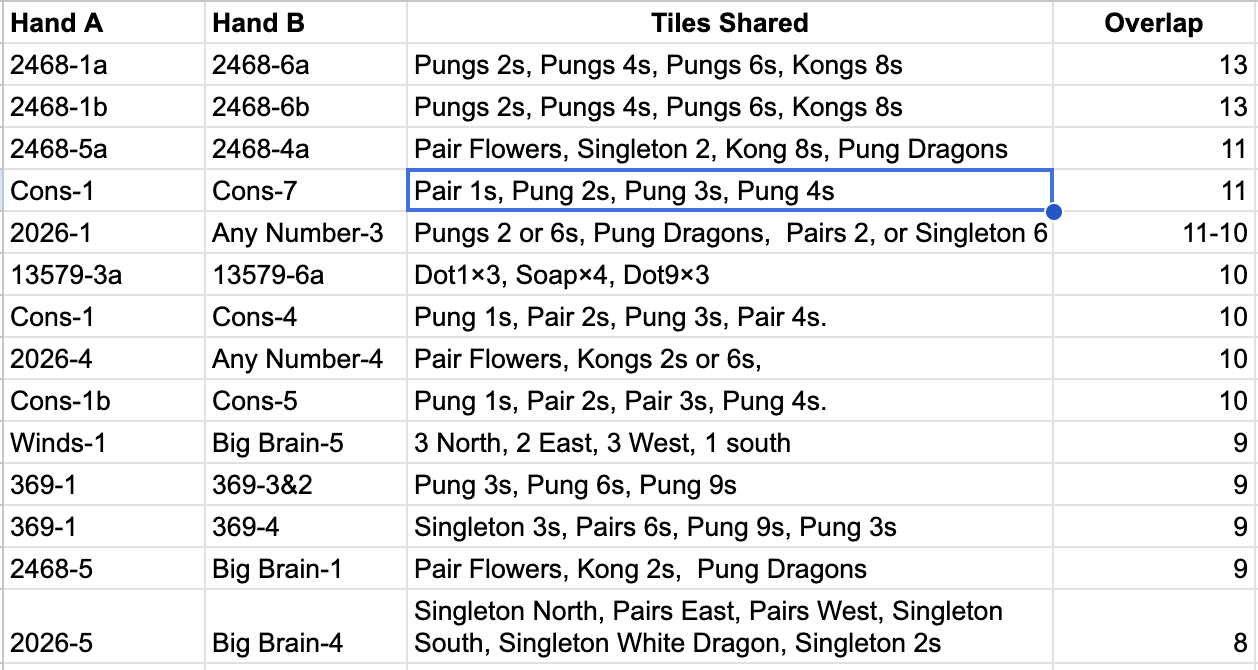
Do this across every tile in the hand, and you can calculate total overlap. Any pair with 10 or more tiles in common becomes a potential pivot.
Step 3: AI Identifies Pivot Clusters
Instead of just random overlaps, the AI quickly revealed clusters of hands that naturally pivot into each other.
For example, the 2468 section forms a powerful pivot family.
Hands like:
Flower
3 dot 2s
3 dot 4s
3 dot 6s
4 dot 8s
connect to multiple other hands that only change one set or suit. That means if the Charleston gives you a run of even numbers, you may have several viable hands at once.
The same thing happens in sections like:
• 13579
• 369
• Consecutive Numbers
Each of these groups shares a core number structure that creates natural pivots.
Step 4: Use That Insight During the Charleston
Once you see how the card is structured, the Charleston becomes much more strategic. Instead of thinking: “What hand should I play?” You start thinking: “What tile family am I building?”
For example:
If you see many 2-4-6-8 tiles, lean toward the 2468 section.
If you see odd numbers, explore 13579.
If you see 3-6-9 clusters, that may point toward the 369 section.
You’re not committing to a hand yet. You’re committing to a structure that keeps several hands open.
One of the Most Interesting Findings
When the card was analyzed with AI, something surprising appeared. Some numbers act as connectors across multiple sections. On this card, 5s and 6s appear in more pivot families than almost any other numbers. That means a pair of 5s or 6s can keep multiple directions open longer than other tiles. And in Mahjong, flexibility is power.
Why I Love Using AI for Mahjong Strategy
AI doesn’t replace experience at the table.
But it’s incredibly good at spotting patterns across large systems, and a mahjong card is exactly that. By breaking the card into tile inventories and comparing overlaps, AI can reveal:
• pivot hands
• tile families
• strong Charleston holds
• hidden connections across sections
It’s like looking at the card from 30,000 feet instead of line by line. And once you see those patterns, your decision-making during the game becomes much clearer.
Mahjong is a game of patterns, probability, and flexibility. And sometimes, the best way to see those patterns…is to let a little AI do the math.
Here are the pivot hands AI found on The Big Card