
The 2026 NMJL Card: What You Actually Need to Know
Every spring, the same thing happens.
The new card comes out…
and we all just kind of stare at it for a month until we get the hang of it.
Like—okay… now what?
I went a little deeper than usual and really looked at the patterns across the whole card. Not to memorize everything. Just to figure out what actually matters when you’re sitting there with your rack.
(And if you’re like me and don’t want to re-think all of this mid-game, I put the simple version into a little 2026 Card Companion you can keep next to you.)
First—this is a 6 + Flower card If you take nothing else from this, take this:
Hold your 6s & Flowers
That’s kind of the center of everything this year.
6s show up everywhere. Flowers show up way more than you expect. And 1s… are usually the easiest thing to let go of.
I say that because after analyzing 678 hand variations across every section, the number 6 appears in more hands than any other number on the card — 272 hands out of 678. That's nearly 40% of everything on the card. Flowers come in right behind at 238 hands.
I will go through each section, for a full breakdown of the card below. But first things first….
THe Pivot HANDS
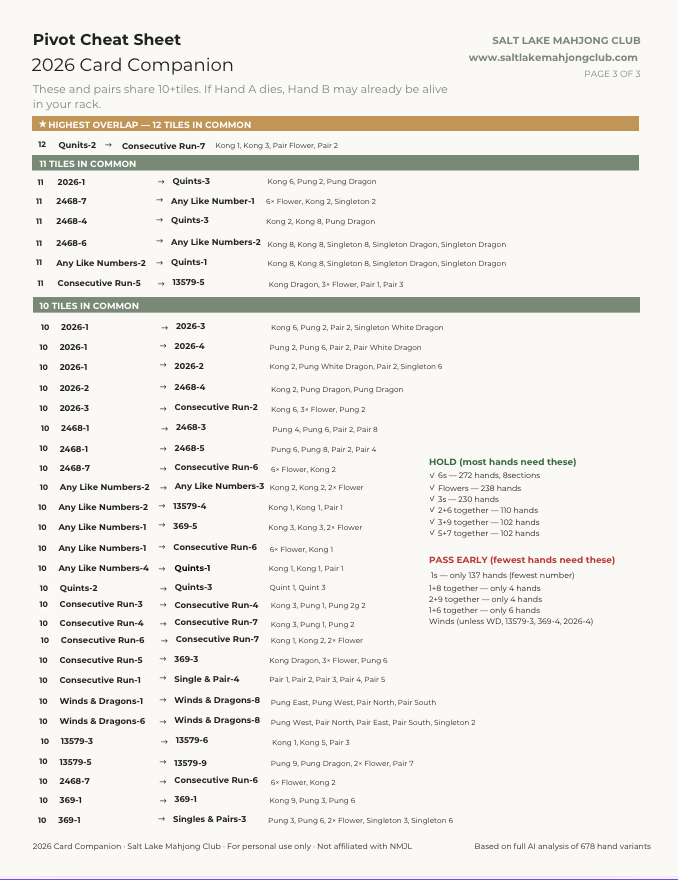
PIVOT HANDS FOR THE 2026 NATIONAL MAH-JONGG LEAGUE CARD
The 2026 section
The 2026 section is exactly what it sounds like — a love letter to this year's digits. But there's more strategy here than meets the eye.
If you have:
2s
6s
a few White Dragons
You’re probably closer than you think. A lot of these hands overlap, so you can kind of sit in it for a while without fully committing right away.
What I love about this section
The pivot opportunities within the 2026 section are exceptional. Our analysis found pairs of hands sharing as many as 14 tiles in common — meaning you can often hold the same rack and be live on multiple hands well into the game. If you have 2s and 6s of the same suit plus some dragons, sit tight. You might have more hands open than you realize.
The strategic secret in this section
Hand 4 — the 22 DD 222 666 NEWS hand — is a sneaky gem. It shares 12 or 13 tiles with multiple adjacent variants because the Winds (NEWS) and White Dragons are fixed while only the suit of your 2s and 6s changes. If you have a pair of Winds early, don't toss them reflexively. Check where you are in this section first.
Quick tip: The 2026 section never uses 1s or 9s. If you're building toward 2026, pass those immediately and focus your Charleston on 2s, 6s, and dragons.This one is actually more forgiving than it looks.
2468
This is one of the richest sections on the card. Eight distinct hand structures, dozens of suit variations, and some of the strongest pivot clusters we found anywhere on the 2026 card.
The 2-4-6-8 section lives and breathes even numbers. And according to the data, 2+6 is the single strongest number pairing on the entire card — 110 hands need both simultaneously. If you're drawing even numbers, especially 2s and 6s together, the 2468 section should be your first stop.
The standout hands this year
Hand 7 (FFF 2468 FFF kong) is a beauty. Six Flowers plus a run of 2-4-6-8 singles plus a kong of one even number. It's flexible, it's elegant, and because it uses six Flowers, it creates massive overlap with the Any Like Numbers section (Hand 1) and the Consecutive Run section (Hand 6). Draw three Flowers and your 2468 hand isn't just a 2468 hand anymore.
Hand 2 (FF 2222 44 66 8888) is one of the most pivotable hands on the card. Our analysis found 12-tile overlap with five other hand variants within the same section — meaning if you're holding a kong of 2s and a kong of 8s with two Flowers, you are very much still in the game even if your pairs of 4s and 6s haven't landed yet.
Quick tip: In the 2468 section, 2s and 8s are the anchor tiles. The middle numbers (4 and 6) are more interchangeable. Build your kongs around 2s and 8s first.
369
The 369 section rewards patience and discipline. Six hand structures built around the 3-6-9 family, and here's what's interesting: the 3+9 pairing is one of the strongest on the entire card (102 hands need both), which means if you're sitting on 3s and 9s, you're not limited to just the 369 section — you've got options in 13579 and Consecutive Run too.
What's new and notable
Hand 5 this year — the FF 3369 3333 3333 structure — is a fascinating hand. Two Flowers, a short sequence of singles (3, 3, 6, 9), and then two kongs of 3s. That's 10 threes total. If you start drawing 3s of different suits, don't panic. This hand was designed for that very situation.
The closed hand (FF 333 666 999 369) at the end of this section is worth studying. It shares significant tile overlap with the Singles & Pairs section's Hand 3, meaning that if you're working the 369 closed hand but find you can't get there, you might have a pivot path into Singles & Pairs.
Quick tip: 6s are the connective tissue of the 369 section. Every single hand in this section uses 6s. Don't pass them.
13579
Odd numbers, big hands, strong pivots. The 13579 section is where 1s, 3s, 5s, 7s, and 9s find their home — and it's one of the most structurally interconnected sections on the card.
Here's the thing about odd numbers on this card: 1s are the least useful (only 6 of the 9 card sections use them at all), but within the 13579 section they're everywhere. The key is committing early. If you're drawing 1s, you're a 13579 player. Act like it.
The Hand 4 family is wild
Floating pair is back, and I am so here for it! 113579 1111 1111. That's one of each odd-number singleton, then two full kongs of the same number. Our analysis found that pairs of Hand 4 variants share up to 14 tiles in common — the highest overlap we found anywhere on the card. If you're in this hand family, you're extremely flexible. Play it out.
Quick tip: In 13579, the 5 is your most versatile tile. It pairs with 7 in 102 hands, with 3 in 101 hands, and with 9 in 74 hands. When deciding between saving a 1 and saving a 5, save the 5.
Consecutive Run
The Consecutive Run section is the most structurally expansive section on the card. Eight hand types, each with multiple number ranges (1-2-3, 2-3-4, all the way to 7-8-9), and suit variations on top. There are more hand variants in this section than anywhere else.
But here's the gift: Consecutive Run hands pivot beautifully into each other. If you're holding consecutive numbers of two suits, you probably have more hands open than you think. Our analysis found Hand 3 (the pair+pair+pung pattern) and Hand 4 (the pung+pung+kong+kong pattern) sharing 10 tiles in common. And Hand 4 shares 10 tiles with Hand 7 (the FF + three-kong structure). That's a pivot chain.
Winds & Dragons
This section rewards players who love holding their Winds early. And this year's card gives Winds players a lot to work with.
The pivot relationships within Winds & Dragons are tight. The two Wind-anchor hands (NNNN EEE WWW SSSS and NNNN EEEE WWWW SSS) share 12 tiles — they're essentially the same hand with the E and W count swapped. And both share 10 tiles with the elegant closed Hand 8, NN EEEE 2D26 WWW SS — which is one of my favorite hands on the card this year because it layers Winds with the 2026 number run.
Quick tip: Winds appear in 159 hands, but most of them are concentrated in this section, the 13579 Hand 3 family, the 369 Hand 4 (NEWS hand), and the 2026 Hand 4. If you don't see yourself near those hands by your fifth draw, Winds become safe throws.
Any Like Numbers
Any Like Numbers is where you go when you've been chasing a hand that didn't materialize. Because any number works, and all three suits apply equally, this section offers refuge.
But here's what most players don't realize: Any Like Numbers hands share significant tile overlap with the Quints section. The Hand 1 structure (kong + 6 Flowers + kong of the same number) overlaps strongly with Quints Hand 1 because both require massing tiles of one number across suits. If you're drawing quadruples of one number early, keep your Flowers — you might have both sections within reach.
The Hand 4 structure (FF + kong + pair + kong + pair drag) is the one I see beginners overlook most often. Two Flowers, then a heavy stack of one number with dragons. It rewards patience and single-number focus.
Quints
The Quints section is exactly what it sounds like: you need five of a kind. Three hand structures, each requiring massive tile concentration.
The Hand 1 structure — quint + kong + quint of the same number — requires 14 tiles of one number across three suits. Fourteen. That's the most tile-intensive demand anywhere on the card. But here's the flip side: because you're working in three suits, the tile availability is actually reasonable. You need five Bam 1s, four Crack 1s, and five Dot 1s, for example. Each suit is a separate draw pool.
Hand 3 — two quints of different consecutive numbers plus a kong of dragons — is where Quints meets strategy. The pivot analysis found these hands share 10 tiles with Any Like Numbers variations. If you're building toward a quint hand, your second number's suit and your dragon type are the late-game decisions. Make them last.
Quick tip: Quints players need to decide by the mid-game. Quinting requires too many tiles to keep alternate paths open. Charleston generously, narrow early, commit fully.
Singles & Pairs
Every hand in Singles & Pairs is a closed hand — meaning you can't claim anyone else's discards. You're building entirely from your draws and the Charleston. That changes how you approach it.
This year's Singles & Pairs section has six hands, and they're genuinely elegant. The Hand 5 (11 357 99 11 357 99) structure — four 1s, pairs of 3, 5, 7, and four 9s — creates a beautiful cross-section with the 13579 section. Our analysis found these hands sharing 14 tiles in common with 13579 Hand 7. If you're playing 13579 Hand 7 (1111 33 55 77 9999) and someone beats you to it, check Singles & Pairs Hand 5. You might already be there.
The closed Hand 6 — FF 2026 2026 2026 — is the gem of this section. Two Flowers plus three sets of the 2026 tile sequence across all three suits. It's the highest-scoring hand in Singles & Pairs at C75, and it's a hand that rewards knowing the card deeply. If you see yourself with 2s, 6s, and Soap tiles of multiple suits, this is where you go.
Quick tip: Because Singles & Pairs is all closed, your Charleston strategy matters more here than anywhere else. You're not getting rescued by a lucky claim. Keep the tiles you need and protect your direction early.
If we were sitting together, here’s what I’d say
Hold:
6s
Flowers
any even pairs
Let go of:
1s early
Green Dragons
random Winds
And just watch for:
2 + 6 together
a lot of Flowers
strong pairs early
That’s really most of it.
(And if you don’t want to remember all of that, that’s literally why I made the Rack Companion—it just sits there and helps you make the call in the moment.)
Final thought
This isn’t a harder card. It just asks you to see patterns a little more.
And once you do, it actually gets really fun.
Because instead of staring at your tiles…you look down and think, “oh—I know where I’m going.”
And that changes the whole feel of the game.
If you end up using the 2026 CardCompanion alongside this, I hope it makes things feel a little easier, a little lighter, and a lot more fun.
